IVF: In Vitro Fertilization
When Natural Conception Needs a Helping Hand

"*" indicates required fields
"*" indicates required fields
When Natural Conception Needs a Helping Hand

What You Need To Know About IVF Treatment in Malaysia | |
|---|---|
| Length of Procedure: | 30 minutes (egg collection) |
| Preparation: | Fast before the procedure |
| Anesthesia: | Sedation to keep you asleep and pain-free. |
| Overnight/Day care: | Day Care. |
| Risks/Complications of Surgery: | Minimal risk. |
| Recovery: | 30 min – 1 hour after the procedure. |
Located in Bukit Damansara, Kuala Lumpur, KL Fertility Centre is Malaysia’s trusted destination for IVF treatment. With more than 25 years of expertise, we combine internationally accredited laboratory standards with a team of globally recognised fertility specialists to deliver advanced, personalised solutions for infertility, including blocked fallopian tubes, endometriosis, unexplained infertility, and male factor infertility. Every treatment plan is tailored to provide world-class care and peace of mind for patients from Malaysia and abroad.
IVF Cycles From Year 2001
Years of Fertility Expertise
Fertility Centres in Malaysia
Years RTAC Accredited
Although IVF is now widely available, achieving consistently high pregnancy success rates still requires exceptional expertise and precision from both the fertility specialist and the laboratory team.
The process involves three core steps:
Surplus viable embryos can be frozen and used at a later stage, should the couple want to attempt pregnancy again.
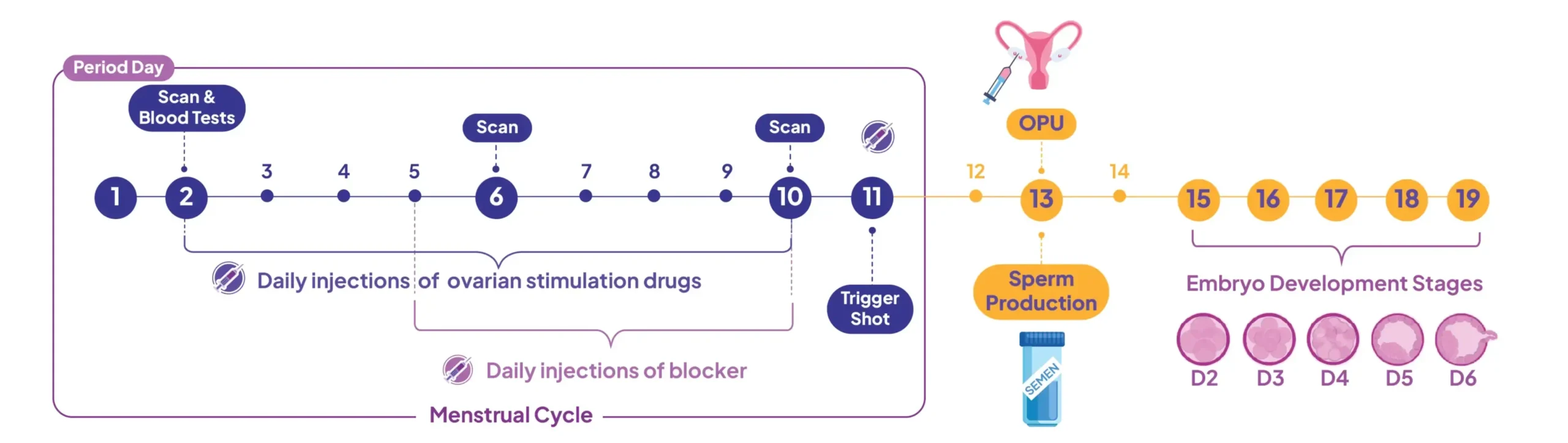
Hormone injections over 10–14 days stimulate the ovaries to produce multiple eggs, monitored by regular ultrasound and blood tests.
Mature eggs are retrieved in a minor day procedure performed under sedation, guided by ultrasound imaging.
A sperm sample is provided by the partner and prepared in the laboratory on the day of egg collection.
Eggs and sperm are combined in the IVF laboratory; fertilised eggs are monitored for embryo development over 3–6 days.
One or more healthy embryos are placed into the uterus in a simple, non-surgical procedure that requires no anaesthesia.
Medications support the uterine lining; a pregnancy blood test is taken approximately 14 days after the embryo transfer.
After the eggs have been collected and fertilised, there are two possible approaches to embryo transfer:
The embryo is placed into the woman’s uterus typically 3 to 5 days after fertilisation, within the same treatment cycle. This is recommended when the uterine lining is in good condition and there are no concerns about ovarian hyperstimulation syndrome (OHSS).
This approach is often chosen when the body and hormones are better aligned, or when couples opt for preimplantation genetic testing (PGT), allowing embryos to be safely frozen while results are processed so only healthy embryos are transferred. Surplus embryos are stored and transferred in a separate, future cycle. Frozen embryo transfer offers comparable success rates to fresh transfers in suitable patients.
Your Fertility Specialist will advise which approach is most appropriate based on your individual response to stimulation and overall cycle assessment.
IVF success rates are not a single fixed number, they vary based on individual patient circumstances. The following factors have the greatest influence on outcomes:
Age is the single strongest predictor of IVF success. Women under 35 typically achieve higher success rates; rates decline progressively after 37 and more significantly after 40.
The quantity and quality of a woman’s remaining eggs, assessed through an AMH blood test and antral follicle count
The developmental stage and morphology of the embryo at the time of transfer are key determinants of implantation success.
Certain diagnoses, such as unexplained infertility or mild male factor, carry different prognoses compared to more complex conditions.
The quality of the IVF laboratory — including culture conditions, equipment, and embryologist expertise — directly affects fertilisation rates and embryo development.
Smoking, excess alcohol consumption, obesity, and unmanaged stress are all associated with reduced IVF success rates.
KL Fertility Centre’s Fertility Specialists discuss each patient’s individual success probability during the initial consultation, based on their full diagnostic profile.
When considering IVF, it’s important to know that the cost is made up of several essential parts. It is not just one fee but a combination of services and expertise that supports your journey.
By combining EPF withdrawal with income tax rebates, couples can significantly reduce the out-of-pocket expenses of IVF. This ensures that financial concerns don’t stand in the way of starting or growing your family.
For full eligibility criteria and step-by-step guidance, visit the KWSP Fertility Treatment page or contact our team. We will walk you through both EPF and tax rebate options with clarity and care.
Knowing what to expect at each stage reduces uncertainty and helps you approach treatment with confidence. Here is a practical guide to preparing for your IVF cycle at KL Fertility Centre.
What to Prepare | Details | |
|---|---|---|
| Advanced analytics | ||
| Initial Consultation | Attend a full assessment with your Fertility Specialist before starting. This establishes your baseline (ovarian reserve, semen analysis, and pelvic ultrasound) and allows the team to design a protocol suited to your diagnosis. | |
| Custom branding | ||
| Understand Your Medication Protocol | Your Fertility Specialist will walk you through the injection schedule. Most patients self-administer hormone injections at home. The nursing team is available to guide you through administration. | |
| Storage integrations | ||
| Plan for Monitoring Appointments | Expect several clinic visits during ovarian stimulation for blood tests and ultrasound scans to monitor follicle development. These are typically short appointments but require flexibility in your schedule. | |
| AI assistant | ||
| Plan for Recovery After Egg Collection | Egg collection is a day procedure performed under sedation. Arrange for someone to drive you home and allow 24–48 hours of light rest before returning to normal activities. | |
| Automated reports | ||
| Lifestyle Adjustments | Avoid smoking and limit alcohol in the weeks leading up to treatment. Maintain a healthy weight and discuss any supplements or medications you are taking with your Fertility Specialist before starting. | |
| Automated reports | ||
| Emotional Preparation | IVF can be emotionally demanding. Speak openly with your Fertility Specialist and nursing team. They are here to support you through every stage of the process. Couples may also choose to book a consultation with our Support Counsellor, who provides a safe space to talk through feelings, manage stress, and build resilience during treatment. | |
KL Fertility Centre’s IVF success rates are reviewed and reported in line with RTAC (Reproductive Technology Accreditation Committee) standards: the same international quality framework used by leading fertility clinics across Australia and the Asia-Pacific.
In 2025, KL Fertility Centre recorded good clinical pregnancy rate for women under 35 undergoing IVF treatment.
IVF success is influenced by many factors, including age, ovarian reserve, embryo quality, and each couple’s individual diagnosis.
At KL Fertility Centre, our specialists don’t rely on averages alone. During your initial consultation, they will discuss your personalised probability of success, based on your unique medical profile and treatment plan.
For those who want to explore the numbers in detail, we provide comprehensive statistical data on our IVF Success Rates page. This transparency helps couples make informed decisions with confidence.
Benchmarked against RTAC standards: the same framework used by leading fertility clinics across Australia and the Asia-Pacific.
60+ years of collective expertise delivering proven outcomes across thousands of journeys.
On-site IVF laboratory accredited under RTAC and maintained to international quality standards, supporting optimal embryo development.
Here in KL Fertility Centre, we pride ourselves in providing high quality IVF services in Malaysia, with high success rates that are comparable to international standards.
IVF treatment is recommended for couples facing various fertility challenges, including blocked fallopian tubes, severe male factor infertility, endometriosis, or unexplained infertility. It’s also suitable for women with diminished ovarian reserve or those who haven’t succeeded with other fertility treatments.
Our Fertility Specialists will evaluate your specific situation through comprehensive testing to determine if IVF is the right option.
Depending on your most recent test results, our Fertility Specialist will review your case and may recommend a reassessment to determine your current fertility status.
Yes, it may be possible to transfer your frozen embryos to our clinic for treatment with our Fertility Specialists. However, due to the strict protocols and code of practices set by RTAC (Reproductive Technology Accreditation Committee), we first need to verify that the laboratory currently storing your frozen embryos is RTAC accredited.
Additionally, a consultation with our Fertility Specialist is required before proceeding with any treatment or relocation of your embryos (including frozen eggs or sperm).
Yes, we do offer Preimplantation Genetic Testing (PGT). We provide two main types of preimplantation genetic testing:
Our Fertility Specialists will work closely with you to determine which type of PGT best suits your individual needs and circumstances.
After an assessment with our Fertility Specialist, they’ll advise when your body is in the best condition to begin IVF. Typically, this process takes about 1-2 months, but it truly depends on your individual fertility status.
Yes, age significantly influences IVF success rates, primarily due to changes in egg quality and quantity. Women under 35 generally experience higher success rates, while those above 35 may benefit from advanced techniques like genetic testing of embryos. Your chances will be discussed in detail during your consultation, taking your age and other factors into account.
Yes, IVF can be enhanced with various complementary treatments to improve success rates. These may include ICSI (Intracytoplasmic Sperm Injection) for male factor infertility, genetic testing of embryos (PGT-A), or assisted hatching. These options are considered based on your diagnosis and treatment goals to help improve the likelihood of success.
Most patients can continue working throughout much of their IVF journey. While egg retrieval may require a day or two off. The embryo transfer is usually a brief procedure, and your care team will help you coordinate your schedule for minimal disruption.
No, IVF does not guarantee 100% success. When we talk about IVF success rates, we are describing the likelihood of achieving a live birth from treatment cycles. In 2025, KL Fertility Centre recorded good a clinical pregnancy rate for women under 35. Success varies depending on factors such as age, ovarian reserve, embryo quality, and the underlying cause of infertility.
Yes. KL Fertility Centre welcomes patients from across Malaysia and around the world. To make treatment accessible, the clinic offers a structured IVF From Abroad programme, carefully designed to minimise the number of trips required to Kuala Lumpur.
For international patients, support services include guidance on visa extensions and assistance with travel planning. Full details of the programme are available on the IVF From Abroad page, and the team is also reachable directly via WhatsApp for advice.