Anti-Müllerian Hormone (AMH): What It Reveals About Your Fertility
Understanding Your Ovarian Reserve Hormone

Understanding Your Ovarian Reserve Hormone
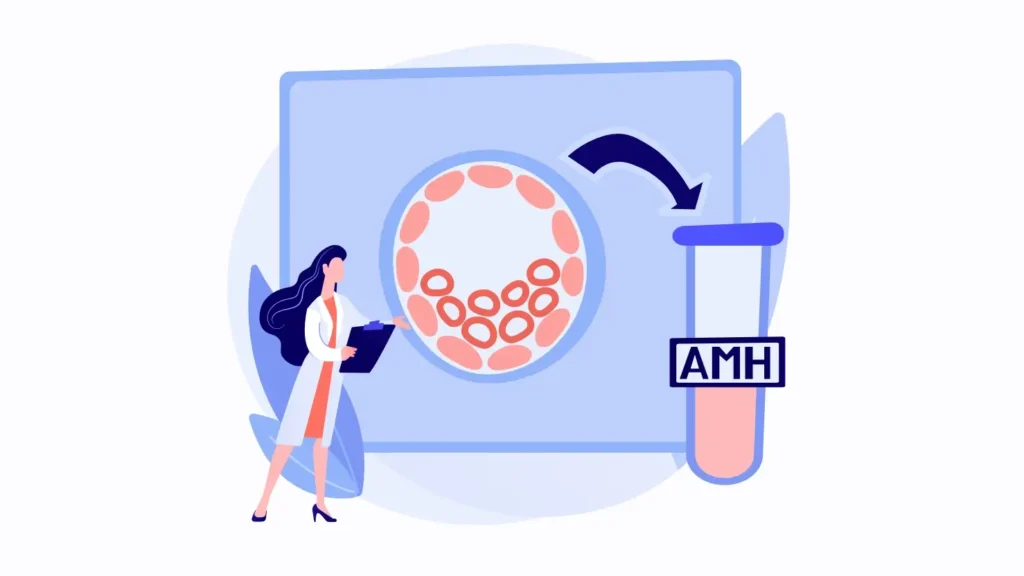
Anti-Müllerian Hormone, or AMH, is a hormone produced by the cells lining the small follicles in a woman’s ovaries.
The level of AMH circulating in your bloodstream strongly correlates with the number of growing follicles that can potentially ovulate. This is why AMH is often used as a marker for your ovarian reserve (the remaining supply of eggs).
Because AMH levels remain stable throughout a monthly cycle, you are able to check your AMH levels at any day. Unlike some other hormone tests, it does not require specific cycle-day timing.
For how AMH fits alongside FSH and AFC as part of a complete ovarian reserve assessment, see our Ovarian Reserve page.
Beyond estimating ovarian reserve, your AMH result plays a direct role in how your Fertility Specialist plans an IVF or ICSI cycle. Your AMH level helps the team:
AMH informs treatment planning rather than replacing it. Your Fertility Specialist will always interpret your AMH result alongside your age, AFC, and overall fertility history before finalising your protocol.
An AMH number on its own does not tell the full story, which is why your result is never reviewed in isolation at KL Fertility Centre. Here is what actually happens once your Fertility Specialist has your result:
Your specialist reviews it alongside your AFC and FSH results before drawing any conclusions. A lower AMH does not mean your egg quality is poor. It means your specialist will pay closer attention to how many eggs might realistically be retrieved during a treatment cycle, and may recommend starting treatment sooner rather than later.
This is sometimes linked to conditions such as PCOS. Your specialist will check for other PCOS indicators before drawing conclusions, and will plan your stimulation protocol carefully to reduce the risk of Ovarian Hyperstimulation Syndrome (OHSS).
Your specialist will still consider your age, AFC, and personal fertility history together, since a “normal” AMH on its own does not confirm how easily you will conceive.
This is also why KL Fertility Centre’s IVF success rates are reported and benchmarked against RTAC (Reproductive Technology Accreditation Committee) standards, the same framework used by leading fertility clinics across Australia and the Asia-Pacific: your AMH result feeds into a treatment plan built around measurable, accountable outcomes, not a single number in isolation.
AMH testing at KL Fertility Centre rarely stands alone. Depending on your result, it often connects directly to other areas of care we provide:
An unusually high AMH may prompt a PCOS assessment alongside other clinical criteria.
Helps estimate how many eggs may be retrieved in an elective egg freezing cycle.
Informs stimulation dosing and the choice between IVF and ICSI
Provides a baseline before chemotherapy, radiation, or ovarian surgery. Speak to our team to discuss options.
The price of an AMH test can vary depending on a few factors: whether it is booked as a standalone anti mullerian hormone test or bundled with a broader fertility assessment, whether it is ordered as part of an IVF work-up (where it may already be included), and which laboratory processes the sample. It is also worth checking our Fertility Assessment Package, which bundles AMH alongside other core fertility tests. See our current AMH test price in the FAQ below.
Your AMH result is reviewed by a Fertility Specialist alongside your full fertility history, not handed to you as a number on its own.
AMH testing can be combined with FSH, AFC, and other evaluations for a complete picture of your ovarian reserve.
Unlike cycle-day-specific hormone tests, AMH can be drawn on any day, with results typically available within days.
25+ years interpreting AMH and ovarian reserve results to guide real treatment decisions, not just report a lab value.
Book an AMH test with KL Fertility Centre and discuss your personal result with a Fertility Specialist.
Low AMH is most commonly associated with age-related decline, but can also result from conditions such as premature ovarian insufficiency, prior ovarian surgery, chemotherapy or radiation treatment, and certain genetic factors. Some studies have also associated smoking with lower AMH levels.
Higher-than-expected AMH is commonly seen in Polycystic Ovary Syndrome (PCOS), where a higher number of small antral follicles leads to increased AMH production. Elevated AMH is a supporting finding rather than a standalone diagnosis, and your Fertility Specialist will consider it alongside other clinical signs.
There is currently no proven medical treatment that reliably increases AMH, since it reflects the number of eggs remaining, which cannot be regenerated. Supplements such as DHEA or CoQ10 are sometimes discussed in fertility care, but their effect on AMH specifically is not well established. Your Fertility Specialist can advise on realistic expectations based on your result.
An AMH test is a simple blood draw, similar to a routine blood test. No fasting is required, and it can be performed on any day of your menstrual cycle. Results are typically available within a few days.
Coverage varies by insurance provider and policy. Fertility-related tests, including AMH, may be eligible under EPF Account 2 withdrawal for fertility treatment in some cases. We recommend checking with your insurer, referring to the KWSP Fertility Treatment page for current eligibility, or speaking with our team for guidance.
Not exactly. AMH is sometimes informally described as a marker of “ovarian age” because it reflects how many eggs remain compared to typical levels for your chronological age. However, AMH does not replace your actual age as a factor in fertility planning, and two women of the same chronological age can have very different AMH levels.
AMH can give a general indication of declining ovarian reserve, but it is not considered a precise predictor of the exact age of menopause for an individual. It is better used as a current snapshot of ovarian reserve for fertility planning than as a long-term forecasting tool.
The price for an AMH blood test is consistent whether it is performed as a standalone test or as part of a comprehensive Fertility Assessment Package. To receive the most up-to-date pricing or to book your test, please contact our team.
There is no single AMH level that defines a “good” chance of pregnancy. AMH indicates egg quantity (ovarian reserve) rather than egg quality, and a higher result does not guarantee easier conception. Your Fertility Specialist will interpret your levels alongside your age, AFC, and clinical history for a complete assessment.
Yes, pregnancy is still possible at 37 with a low AMH level. While fertility and egg quality naturally decline in the late 30s, low AMH alone does not make pregnancy unlikely. However, given the combination of age and ovarian reserve, it is beneficial to consult a Fertility Specialist sooner rather than later to assess your fertility and discuss the best options for your circumstances.